
I use a few behavioral hacks to manage my executive-function challenges. The simplest is a weekly email to myself reminding me to make reservations for date night that weekend. I have been doing this in one form or another for decades.1 Pre-pandemic, the most desirable dinner reservations at popular restaurants were for the 7:00 to 7:30 slot. But as of late, the earlier time slots have become increasingly popular.
6:30 is the new 7:30.
I can’t tell you for sure why this is; maybe people are excited about getting home to stream the latest season of Lioness or Ted Lasso? Perhaps the entire nation is aging and inching towards that 4:30 Early Bird Special Florida is justly famous for? Regardless, a variety of factors have led to a regime change in dining out.
Which brings me to inflation data and the latest Federal Reserve meeting.
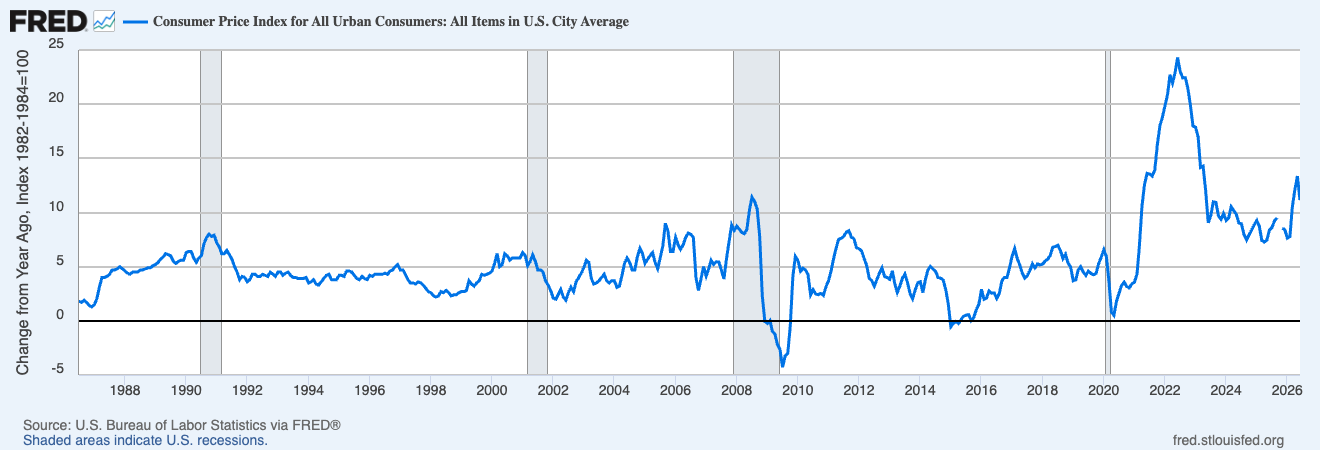
Most of the commentary and chatter is about the lack of communication from newly installed Federal Reserve Chairman Kevin Warsh. But the more important issue – and perhaps why Warsh was so reluctant to speak publicly under the guise of his new communications policy – is the simple recognition that 2% is, was, and always has been a fabricated, made-up number.
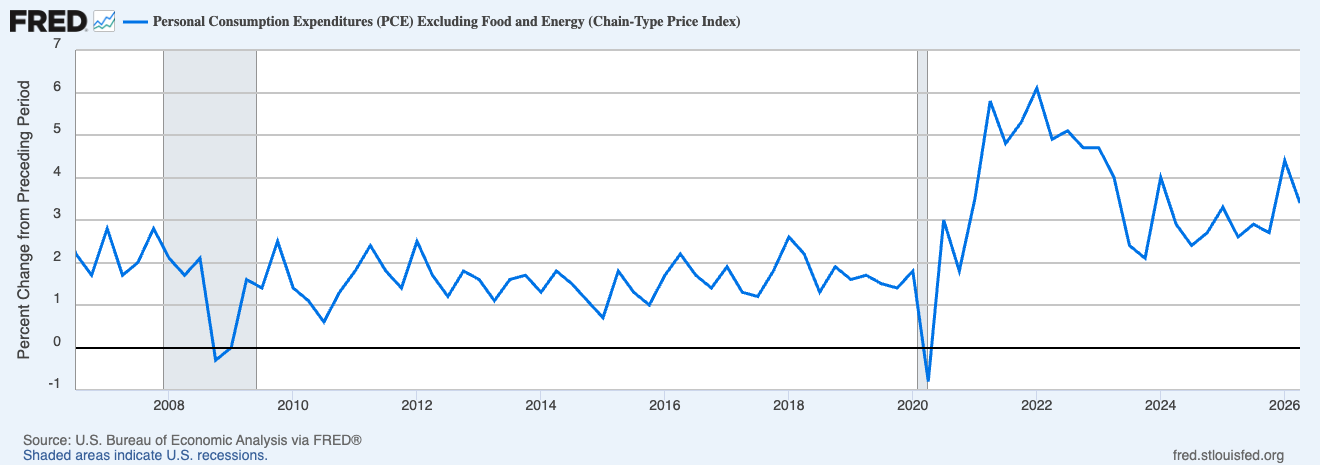
The decade that followed the Great Financial Crisis (GFC) was primarily defined by quantitative easing (QE) and zero interest rate policy (ZIRP), with deflation rather than inflation the greater concern. While 2% was a made-up number, it served as a reasonable upside target during an era of flat-to-negative price changes.
Then came the pandemic, and the single largest fiscal stimulus as a percentage of GDP since World War Two.2 That shift from an era of monetary stimulus to fiscal stimulus was a regime change unlike anything seen since Paul Volcker was chairman of the FOMC.3
3% is the new 2%.
This is neither complicated nor difficult to understand. Yet Wall Street investors and bond traders have been unwilling to accept it for the better part of six years. It took the vacuum created by a reluctant Federal Reserve chair to create an environment in which an obvious error—that silly 2% target—is being replaced by a less obvious error of a somewhat less silly target of 3%.
This matters. How much so depends on whether you are a bond owner, mortgage holder, carry credit card or student loan debt, or are shopping for a new house or car. Or, if you are the FOMC chair fighting against inflationary policies, including War in the Middle East and Tariffs.4
See also:
Warsh: “We’re Sticking With It” … Until January
Claudia Sahm, Jul 30, 2026
Forward Guidance won’t make you happier
Allison Schrager, Aug 03, 2026
Warsh Floats Cut in Number of Fed Rate-Setting Meetings
By Nick Timiraos
WSJ, July 31, 2026
Previously:
2% Inflation Target is Silly (July 26, 2023)
A Dozen Contrarian Thoughts About Inflation (July 13, 2023)
Why Is the Fed Always Late to the Party? (October 7, 2022)
Transitory Is Taking Longer than Expected (February 10, 2022)
Footnotes:
1. The reminder was initially in Outlook, then G-Cal and now from Followupthen.com. It originally included a list of restaurants local to home, NYC, and our vacation property. That morphed into OpenTable, and then Resy also.
2. As detailed here:
“The 2% inflation target is LITERALLY a random number that originated in New Zealand in the 1980s.2 Roger W. Ferguson Jr., former Vice Chairman of the Federal Reserve observed in a recent CFR note, “Surprisingly, it came not from any academic study, but rather from an offhand comment during a television interview.” For reasons no one has intelligently articulated, other countries subsequently adopted it as their target.”
3. There is a longer explanation about the excess 2010 era of ZIRP as it applied to not disrupting bank balance sheets still festooned with iffy loans that would have been increasing put at risk if rates were allowed to find their natural levels post-GFC…
4. That most of the inflation drivers are coming from policy decisions that led to self-inflicted errors is a conversation I will leave for the policy wonks and historians to discuss…
