
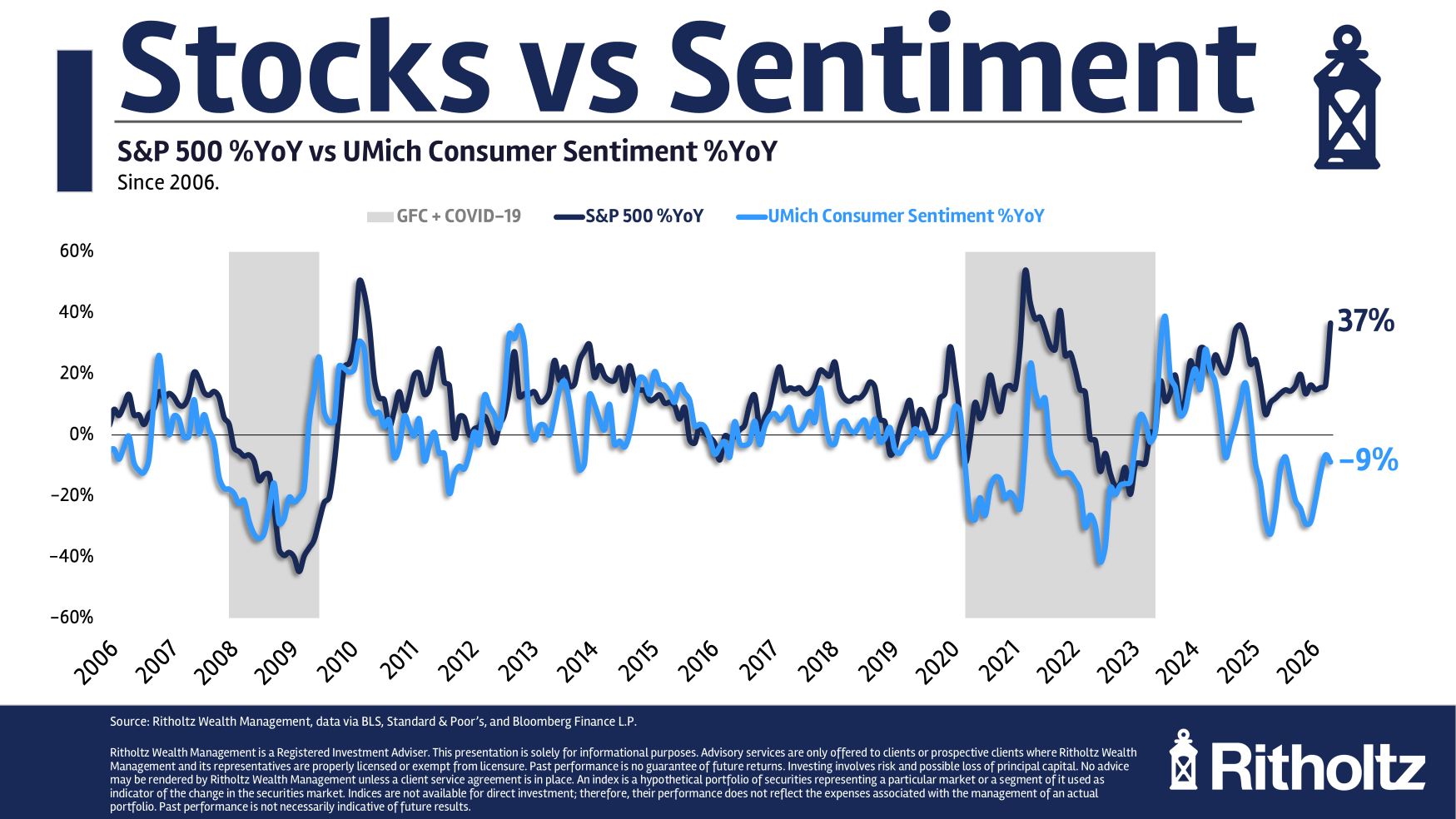
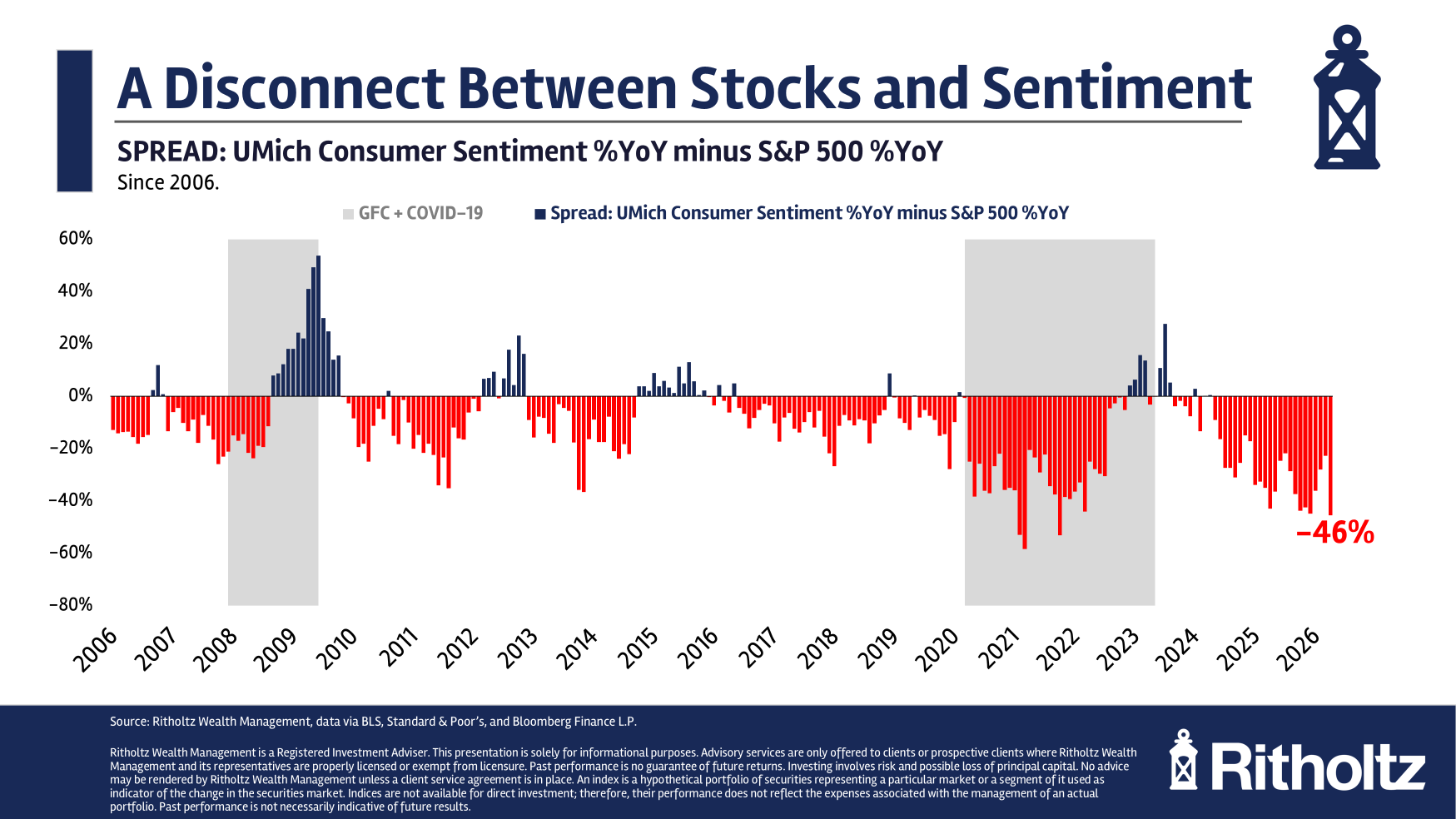
The stock market is hitting all-time highs, even as consumer sentiment hits all-time lows.
Is this a paradox?
Hardly.
The confusion stems from people who imagine market prices move off their personal economic experiences (as well as broader consumer sentiment). This is a false belief, easily disproven with a few data points and charts.
“This market makes no sense!”
A similar anomaly occurred during the pandemic. The S&P 500 kept making new all-time highs even as your local economy was faltering. Stores were closing, unemployment was surging, and airlines, hotels, and retailers were going bust.
New all-time highs seemingly ignored all of that. The explanation for this was simple, albeit wonky: Your personal economy is local, visible, and “availability-weighted” while the S&P 500 is global, but more importantly, market-cap weighted. 1
Today’s anomaly is similar.
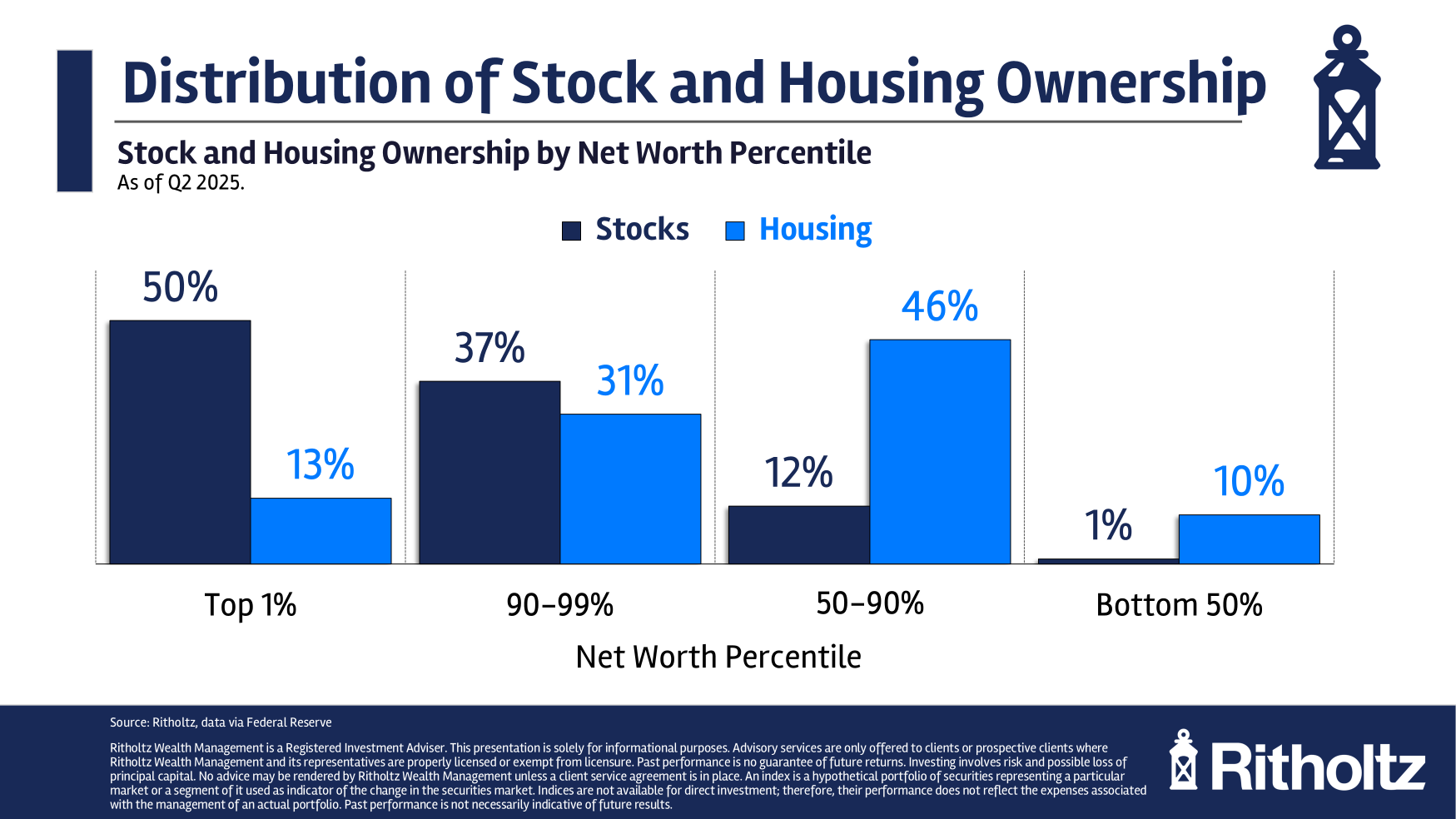
As it turns out, psychology matters – just not your psychology. When we look at the ownership structure of assets in the United States, we see a very lopsided distribution. The top 1% owns half of all equities in the US; the top 10% owns 87%.
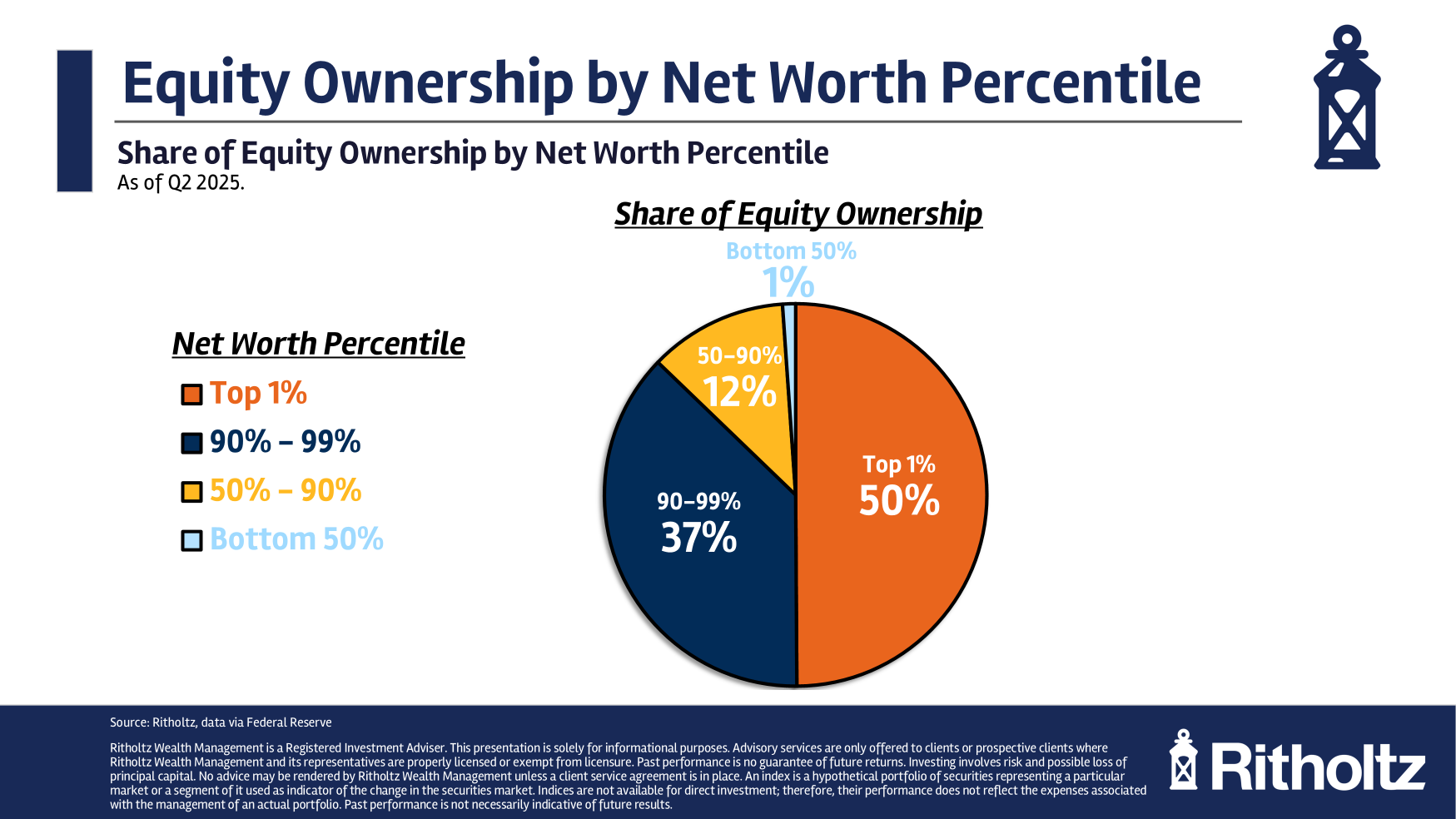
How much do you think the sentiment of the bottom 90% of the population, by net worth – they own just 13% of stocks – matters to the stock market?
Not very much.
A related point is the so-called Wealth Effect – it’s mostly nonsense, a case of correlation, not causation.2
The lopsided distribution of equity ownership in the country explains a lot of things; it is especially useful when explaining why sentiment at all-time lows does not seem to have much effect on markets.
What is impacting overall sentiment? Consider:
Inflation had dropped from 9% down to 2.5ish%, mostly under control – until the tariffs began to drive prices higher. 3
Iran War took most Americans by surprise; the reasons were not explained to the country, and so it remains unpopular. (Sending gas prices up $1 a gallon is not popular either).
Home prices remain high, with starter homes out of reach for most young people.
Measurement issues are a very real problem when it comes to identifying sentiment. The same problem exists in polling and other measures of intention and psychology.
The K-Shaped Economy has led to a majority of Americans not feeling optimistic about the current or future economic situations.
That K is a real phenomenon: The wealthy are doing better than ever – their biggest assets are real estate (ATHs), stocks (ATHs) and businesses (awash in PE money) are all doing great; Oh, and thanks for renewing the 2016 TCJA giant tax cuts for another decade.
We see this manifest in spending patterns also. About half of all retail sales are driven by the top 10% of consumers.4
~~~
It’s never quite as clear-cut as some claim – extreme rallying cries are great clickbait but hardly explain the complexities and nuances of the markets.
Yes, markets have been democratized (somewhat) over the past 50 years. But ownership is still primarily held by the wealthy. If you want sentiment to match market prices, try surveying billionaires and millionaires instead of ordinary people…
See also:
If America’s So Rich, How’d It Get So Sad? (Derek Thompson Apr 23, 2026)
Why the Stock Market Makes No Sense Right Now (New York Times, April 18, 2026)
Aftermath: Wall Street Is Lying to Itself (Prospect, April 23, 2026)
Previously:
Revisiting the Wealth Effect (October 23, 2025)
The Probability Machine (August 28, 2025)
The K-Shaped Recovery (September 4, 2020)
Maybe Mr. Market Is Rational After All… (August 7, 2020)
Wealth Effect Rumors Have Been Greatly Exaggerated (November 16, 2010)
Why the Treasury Secretary is Wrong on the Wealth Effect of Stocks vs Real Estate (October 26, 2006
UPDATE: April 24, 2026 10:00 am
Latest U Mich Comsumer Sentiment Final April data
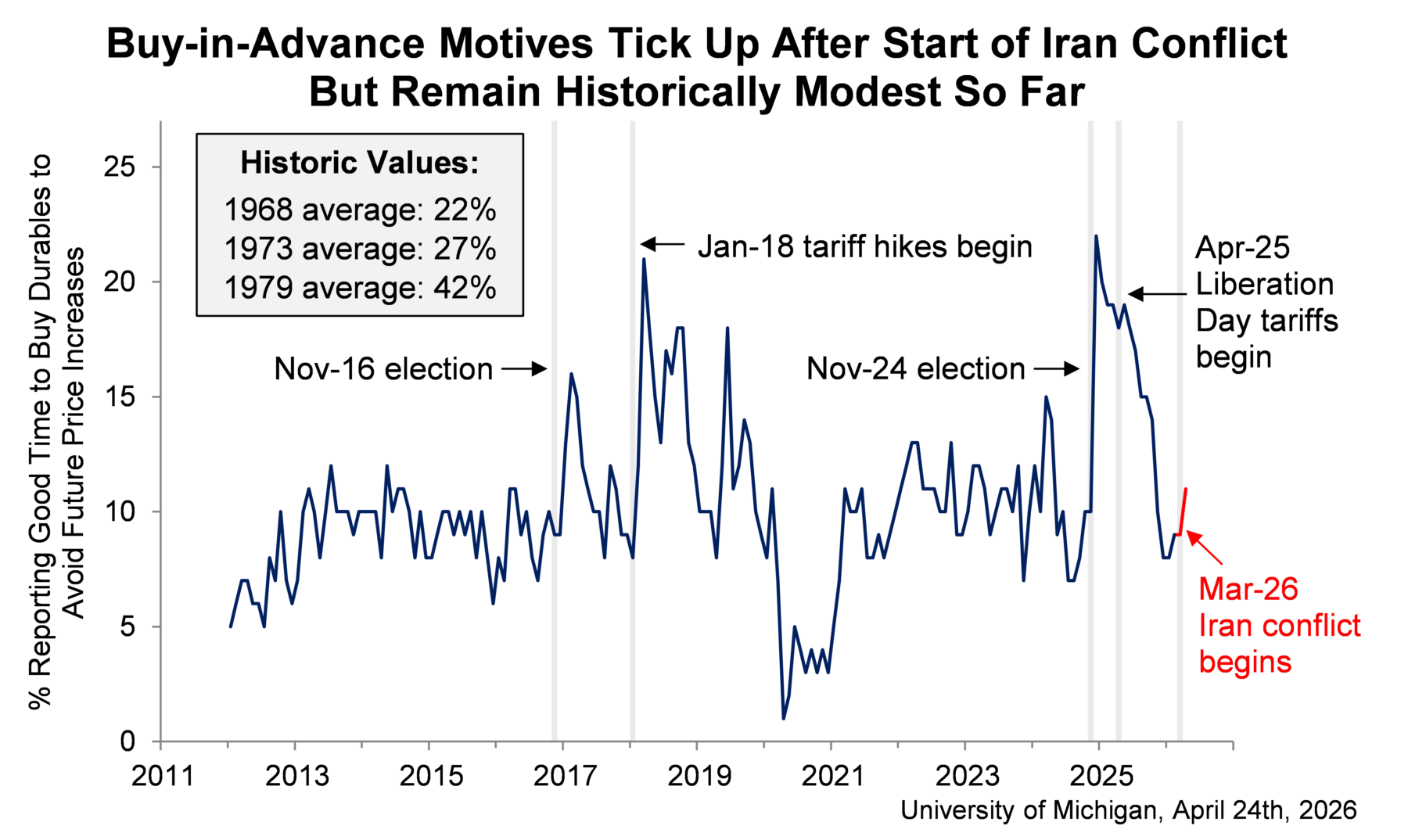
Source: U Mich
__________
1. The “availability heuristic” is our tendency to use information that comes to mind quickly and easily as opposed to the more nuanced, complex real world.
Wikipedia: “mental shortcut that relies on immediate examples that come to a given person’s mind when evaluating a specific topic, concept, method, or decision. This heuristic, operating on the notion that, if something can be quickly recalled, it must be important, or at least more important than alternative solutions not as readily recalled.”
2. There IS a real wealth effect with housing – the bottom 90% own 87% of the houses – pretty close to what you expect. But even those numbers are skewed; the lower half of households – AKA renters – only own 10% of the housing stock. So the wealth effect of housing real, but somewhat muted to the 100 million owners of their primary residences.
3. The media has a big impact on sentiment, and except for the Artemis II mission, the headlines have been mostly negative. Other factors be weighing on sentiment include Home prices, health care costs, Ukraine War, ICE murders, Epstein files, etc.
4.Bloomberg: “A Moody’s Analytics analysis of Fed data found the top 10% of earners were responsible for about 49.2% of total U.S. consumer spending in Q2 2025, the highest share in data going back to 1989.” (September 16, 2025)
5. Markets trade off of profits and growth which often have nothing to do with your personal economic situation.
